
Belfast rarely leaves anyone feeling indifferent. You can stand on one street looking at a peace wall, turn a corner to find a mural filled with political memory, and realise very quickly that the city’s recent past is still written into its streets. If you are searching for the top Belfast sites about Troubles history, the key is not simply finding the right places on a map. It is understanding what happened there, who was affected, and why these sites still matter now.
The Troubles were not a single event or one-sided story. They were a long and painful conflict shaped by politics, identity, territory, discrimination, loss and deeply held loyalties. That is exactly why Belfast rewards a thoughtful visit. The best sites are not only visually striking. They give you a sense of how ordinary lives were shaped by extraordinary tension.
Why the top Belfast sites about Troubles history need context
Some visitors arrive expecting a checklist of famous landmarks. Belfast does not work like that. A mural is never just a mural here, and a wall is never simply a wall. The city’s most significant Troubles-related sites sit within living communities, many of them still divided by interface barriers and shaped by memory.
That means context matters as much as location. The same place can mean something very different depending on whether you are hearing a republican, loyalist, British Army, prison officer, survivor or local resident perspective. A balanced visit is always the better one. It helps you move past slogans and towards the human reality.
Falls Road murals
The Falls Road is one of the first places many visitors think of when they want to understand republican Belfast. The murals here are among the city’s best known, but they are not static pieces of street art put up for tourists. They reflect political beliefs, remembrance, solidarity campaigns and local identity.
Some murals focus directly on the conflict in Northern Ireland. Others connect Belfast’s experience with wider international struggles. That can surprise first-time visitors, but it tells you something important about how communities framed their own story. You are seeing not only images, but statements of belonging, loss and resistance.
The trade-off is that without explanation, it is easy to misread what you are looking at. If you only see bold colours and dramatic faces, you miss the layers underneath.
Shankill Road murals
To understand Belfast properly, the Shankill Road is every bit as important. This area is central to the story of loyalist Belfast, and its murals, memorial gardens and painted kerbstones express a very different political identity and historical memory from those found on the Falls.
This is one of the reasons the top Belfast sites about Troubles history should never be visited in isolation. The Falls and the Shankill are geographically close, yet historically and emotionally worlds apart in many respects. Seeing both gives visitors a clearer sense of how division took shape, and how two communities could live side by side while holding very different views of the same conflict.
The best approach is respectful curiosity. These are residential districts, not open-air museums detached from daily life.
The peace walls and interface areas
Few Belfast sites make the legacy of The Troubles feel as immediate as the peace walls. Built to reduce violence between neighbouring communities, these barriers remain one of the most striking physical reminders that conflict does not simply vanish when agreements are signed.
For many visitors, seeing the gates, fencing and separation lines is the moment the history stops feeling abstract. You can read about sectarian division in a book, but standing beside a wall that still closes at certain points brings home how recent and how local the conflict was.
There is also an uncomfortable truth here. Peace walls were intended as protective measures, yet they also normalised separation. That is part of Belfast’s complexity. What keeps people safe in one period can also preserve division into the next.
Messages written by visitors on sections of the wall often express hope, but the setting itself is a reminder that reconciliation is an ongoing process, not a finished one.
Clonard Martyrs Memorial Garden and nearby interfaces
This part of west Belfast offers a concentrated sense of how close conflict came to people’s homes, churches and daily routines. The Clonard area sits near one of the best-known interfaces in the city, and the memorial spaces here reflect the intensity of violence experienced locally.
It is not a grand landmark in the traditional sense. That is precisely why it matters. Sites like this show how remembrance is woven into neighbourhood life. For visitors who want more than headline history, it is often the smaller memorial spaces that leave the strongest impression.
Crumlin Road Gaol
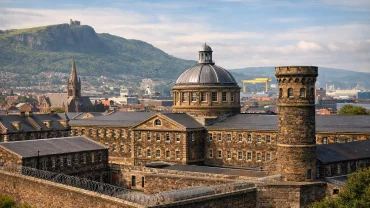
If you want to understand imprisonment, internment, protest and the wider justice and security dimensions of The Troubles, Crumlin Road Gaol is essential. The building itself predates the conflict, but its role during the Troubles makes it one of Belfast’s most important historical sites.
Republican and loyalist prisoners were held here, and the gaol opens a window onto a part of the conflict that remains deeply contested. For some, imprisonment is tied to criminality. For others, it is tied to political struggle and state power. You do not have to settle every argument to recognise that prison shaped the conflict in major ways.
Visitors often find this site especially powerful because it combines architecture, atmosphere and hard history. Cells, corridors and holding spaces make abstract political debates feel immediate and personal.
Crumlin Road Courthouse exterior and surrounding area
Directly across from the gaol, the courthouse adds another layer to the story. Even viewed from outside, it helps explain the legal and security framework that surrounded the conflict. Trials, charges, sentencing and public controversy all formed part of Belfast’s Troubles landscape.
This is not usually the most emotional stop on a first visit, but paired with the gaol it helps complete the picture. The conflict was fought not only on streets and in back alleys, but also through institutions.
Milltown Cemetery
Milltown Cemetery is one of the most significant sites of remembrance in Belfast, particularly within republican history. Graves, memorials and funeral histories here connect directly to major events during The Troubles, and the cemetery has been the setting for moments of grief, tension and political symbolism.
For visitors, this is often a quieter stop than the murals or walls, yet no less important. Cemeteries strip away rhetoric. They confront you with the number of lives lost and the families left behind.
As with many Belfast sites, interpretation matters. Without it, a visitor may not recognise the broader significance of particular graves or memorials. With proper explanation, the cemetery becomes a key part of understanding commemoration and collective memory.
The International Wall
The International Wall, close to the Falls Road, deserves its own mention because it captures something distinctive about republican political expression in Belfast. Its artwork changes over time and often responds to global events, anti-racism campaigns, solidarity causes and local anniversaries.
That evolving quality makes it especially interesting. Some Troubles-related sites preserve memory in fixed form. The International Wall shows memory as something active, argued over and continually updated. It is one of the clearest examples of how Belfast’s political storytelling still lives in public space.
Stormont Estate
Stormont is not where most visitors expect to feel the story of The Troubles most strongly, but it belongs on any serious list. Northern Ireland’s Parliament Buildings and political estate are central to understanding the structures of governance, unionism, power-sharing and constitutional debate that formed the backdrop to the conflict.
This is a more political stop than an emotional one, but it matters because The Troubles were never just about violence. They were also about state institutions, representation and competing visions of Northern Ireland’s future. If you only visit community flashpoints, you risk missing that wider frame.
HMS Caroline and the wider Titanic Quarter context
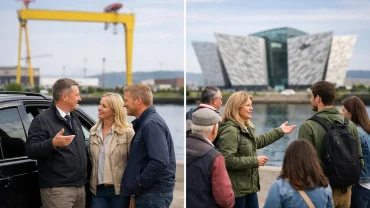
This one depends on your interest. HMS Caroline is not a Troubles site in the same direct way as the Falls, Shankill or Crumlin Road. Still, the wider docklands and east Belfast setting can help visitors understand the city’s industrial history, working-class identity and British connection, all of which shaped the background to later political tensions.
If your time is short, prioritise the more direct conflict sites. If you have an extra half day and want a fuller sense of Belfast beyond the headlines, this area adds useful context.
Seeing Belfast’s Troubles sites with local insight
There is a real difference between visiting these places and understanding them. Street names, murals, memorials and barriers can be powerful on their own, but they make far more sense when explained by someone who knows the city from lived experience and can present more than one side of the story.
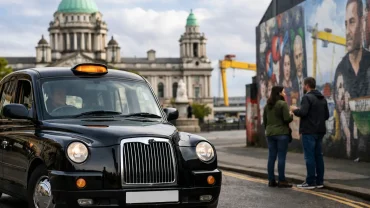
That is why many visitors choose a private black taxi tour rather than trying to piece it all together alone. With Belfast Black Taxi Tour, the value is not simply transport between stops. It is the chance to hear authentic stories, ask honest questions and see how the city’s painful past connects to its present-day character, humour and resilience.
Belfast is not asking visitors to take sides. It is asking them to pay attention. If you give these places the time and respect they deserve, the city gives something back that stays with you long after the trip ends.
Comment (0)