
A Belfast black cab can take you past the city’s most recognisable landmarks, but its real value lies in the stories that do not fit on a postcard. If you are asking what is a black taxi tour, it is a private, guide-led journey through Belfast’s political history, street art, communities and remarkable transformation – told by someone with a genuine connection to the place.
This is not a hurried drive-by sightseeing trip. You step out at key locations, stand beside the Peace Wall, read the murals in their local context and hear how ordinary families experienced extraordinary decades. The result is a far clearer, more human understanding of Belfast than you can get from a guidebook alone.
What is a black taxi tour of Belfast?
A black taxi tour is a private sightseeing experience in a traditional London-style black cab, usually led by a local driver-guide. In Belfast, these tours are particularly known for explaining The Troubles: the period of conflict that affected Northern Ireland from the late 1960s until the Good Friday Agreement of 1998, with consequences and memories that remain part of life today.
The taxi itself matters because it makes the tour personal and flexible. Rather than following a large group with a flag held overhead, you travel with your own party, ask questions as they arise and stop where the story needs more time. A good guide adjusts the conversation to what you already know, whether you are encountering this history for the first time or have come to Belfast specifically to understand it better.
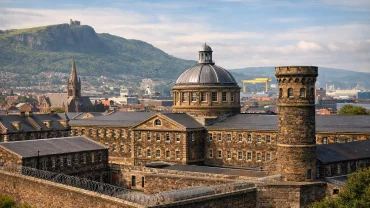
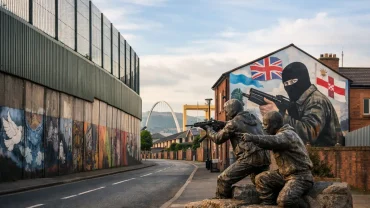
Most tours take in the Falls Road and Shankill Road, two areas long associated with different political traditions. You may visit Republican and Loyalist murals, the peace lines that still separate some neighbourhoods, memorial gardens and viewpoints where the geography of the city begins to make sense. The route can also include places such as Crumlin Road Gaol, depending on the time available and the interests of your group.
More than murals and monuments
Belfast’s murals are often the images visitors remember most vividly. They are powerful, colourful and sometimes challenging, but they are not simply outdoor galleries. They can commemorate people, express political identity, mark grief or reflect changing hopes within a community. Seeing them with an informed local guide helps you understand the message, the history behind it and why it matters to the people who live nearby.
The same is true of the Peace Wall. Visitors are often surprised that these barriers still exist decades after the peace agreement. A tour gives that fact the context it deserves. The walls were built during periods of intense violence to separate neighbouring communities, and their presence speaks to both the progress Belfast has made and the work that is still ongoing.
There is no single experience of The Troubles, and no responsible tour should pretend otherwise. People from Catholic, Protestant, Nationalist, Unionist and other backgrounds may carry different memories, losses and interpretations. The strongest black taxi tours make room for that complexity. They do not reduce a difficult history to slogans or treat real suffering as entertainment.
That balanced approach is central to the experience offered by Belfast Black Taxi Tour, jointly owned by Catholic and Protestant partners. It reflects a simple but meaningful principle: visitors deserve authentic stories and a fair account of the communities whose history they are hearing.
Why a local guide changes the experience
You can read about Belfast’s past before you arrive, and it is worth doing. Yet history looks different when you are sitting on the road where events unfolded, noticing how close two communities are to one another, or hearing a guide explain what daily life felt like at the time.
Many black taxi guides lived through the era they describe. That does not make them historians in an academic sense, nor should personal experience replace wider historical evidence. What it does bring is texture: the practical realities of checkpoints, disrupted routines, fear, resilience, humour and the Belfast craic that helped people carry on. A thoughtful guide connects those personal recollections to the bigger political picture without claiming to speak for everyone.
This is especially helpful for visitors who worry that the subject will be too complicated or uncomfortable. The history is complicated, and parts of it are painful. But a skilled guide can explain it plainly, answer sensitive questions respectfully and leave you with a stronger sense of how Belfast has changed.
A conversation, not a scripted lecture
Private tours are built around conversation. Perhaps you want to understand the origins of the conflict, the role of the British and Irish governments, the impact of the Good Friday Agreement or why certain flags and symbols appear in particular areas. Your guide can meet you where you are.
Equally, you may want to hear about modern Belfast: its food, music, shipbuilding heritage, universities, sport and changing city centre. A black taxi tour can hold both truths at once. Belfast is a city shaped by its past, but it is not frozen in it.
What happens on a typical tour?
Your driver-guide will normally collect you from your hotel, city-centre location, accommodation or, where arranged, Belfast Port. That direct pickup is particularly useful for cruise passengers and visitors with limited time ashore. Once in the cab, the guide introduces the route and begins building the historical background as you travel.
Expect regular stops rather than spending the whole experience behind glass. You might walk up to a mural, take photographs, look across a peace gate or sign a section of the Peace Wall – something many visitors choose to do as a message of hope. At each stop, the guide explains what you are seeing and gives you time to take it in.
Tours commonly last around 90 minutes to two hours, although longer private itineraries can allow for a broader city experience. The exact route depends on traffic, local access, your pickup point and the topics you most want to explore. If you are travelling with children or teenagers, tell the operator beforehand. The history can be explained in an age-appropriate way, but it remains serious subject matter.
Is a black taxi tour right for you?
For many first-time visitors, it is the best introduction to Belfast because it gives the city a framework. You will recognise the names, places and references that come up during the rest of your stay. For heritage travellers, it offers access to firsthand perspective and locations that are easy to miss when exploring independently.
It also suits couples, families and small groups who prefer comfort and privacy. You are not tied to a coach timetable, and the conversation can be as detailed or as gentle as you prefer. Traditional black cabs have character and a close connection with Belfast’s tourism story, while executive vehicle options can be better for larger parties or those seeking additional space.
There are trade-offs. A taxi tour is generally more intimate than a large walking tour, but it may cover less ground on foot. It is also focused primarily on political and social history, so it is not the best choice if you only want a general architecture or shopping tour. Visitors who have a full day may choose to combine it with other Belfast sights, or book an extended excursion along the Antrim Coast and towards the Giant’s Causeway.
How to get the most from your tour
Come with questions, but do not feel pressure to know the terminology in advance. A guide should be able to explain terms such as Republican, Loyalist, Nationalist and Unionist clearly, without assuming political knowledge or asking you to take a side.
Be open to hearing perspectives that may challenge what you have read or been told. Respect the fact that these are living neighbourhoods, not museum sets. Photograph where appropriate, listen carefully at memorial sites and remember that people’s experiences of conflict are deeply personal.
When booking, consider how much time you have, where you need collected and whether there are specific sites you hope to see. Private touring is at its best when it is shaped around your group rather than squeezed into a standard route.
A black taxi tour does not ask you to leave Belfast with a simple answer to a complicated past. It gives you something more valuable: the chance to see the city through local eyes, understand the human stories behind its walls and murals, and meet the Belfast of today with greater respect and curiosity.

Comment (0)