
A Northern Ireland conflict tour is not a casual box-ticking stop between pubs and postcard sights. Done properly, it gives you the history behind the headlines, the human stories behind the murals, and the context that turns Belfast from a city people think they know into one they finally begin to understand.
For many visitors, The Troubles can feel hard to approach. You know the broad outline, but not the detail. You have seen images of walls, soldiers, protests and peace talks, yet you are unsure how those events shaped ordinary streets and families. That is exactly why this kind of tour matters. It is not about sensationalising conflict. It is about making sense of a place through the people who lived it.
What a Northern Ireland conflict tour should really offer
There is a big difference between hearing a rehearsed script and hearing authentic stories from someone who knows these areas as lived places. The best tours do not flatten history into good versus bad, or one community versus another. They explain the political background, the social divisions, the civil rights movement, the rise in violence, the role of the British Army, paramilitaries, prisons, ceasefires and the long, difficult road towards peace.
Just as importantly, they show how that history remains visible today. Belfast is not frozen in the past, but you can still read its story in the streets. Peace walls still stand. Murals still carry memory, identity and political feeling. Neighbourhoods that were once flashpoints still have emotional weight for local people. A strong guide helps you see all of that clearly, without turning it into theatre.
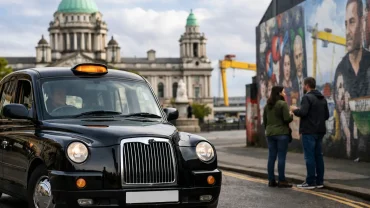
This is where a private black taxi experience stands apart. You are not straining to hear from the back of a large coach or being rushed through a timetable that leaves no room for questions. You can stop, ask, reflect and engage. On a subject as sensitive as conflict history, that makes a real difference.
Why Belfast is the heart of the experience
If you are choosing a Northern Ireland conflict tour, Belfast is where most visitors begin, and for good reason. The city was central to many of the key events of The Troubles, and it still holds some of the most important physical traces of that period.
West Belfast is often the focal point. Here, the Falls Road and the Shankill Road are not just names on a map. They represent communities with different political traditions, different memories and, at times, sharply different experiences of the same years. Seeing these areas with a knowledgeable local guide helps you move beyond clichés. You start to understand why murals matter, why certain anniversaries matter, and why language itself can matter.
The peace lines are another essential stop. Visitors are often surprised that these barriers still exist. They are among the most powerful reminders that peace is a process, not a switch that was simply turned on after the Good Friday Agreement. Standing beside them gives you a more honest sense of where Belfast has come from and where it is still going.
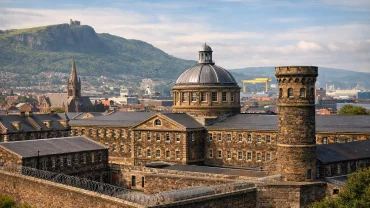
Crumlin Road Gaol also adds depth for many travellers. Its history reaches beyond The Troubles, but for anyone trying to understand conflict, imprisonment, security and political tension in Northern Ireland, it is a meaningful part of the wider picture. Depending on your itinerary, it can complement the street-level stories of the city itself.
Balanced perspective matters more than ever
When visitors tell us they want to understand Belfast, what they usually mean is that they want clarity without bias. That is not always easy to find. The history is contested, the memories are personal, and even now people can carry pain, pride or both.
A balanced perspective does not mean pretending every experience was identical. It means recognising complexity. One family may remember army patrols as protection, another as intimidation. One street may remember a mural as commemoration, another as provocation. These differences are part of the truth, not a distraction from it.
That is why lived experience is so valuable. A guide who grew up with this history can explain not just what happened, but how it felt, how it changed daily life, and how communities have tried to move forward. When that perspective comes from a shared-heritage approach, visitors often feel more confident that they are hearing the city in full rather than one narrow version of it.
What you will see on a conflict tour in Belfast
No two itineraries are exactly the same, especially on a private tour, but most well-designed experiences include the city’s most significant conflict-related sites. Murals are a major part of that. Republican and loyalist murals are visually striking, but their real value lies in what they reveal about identity, memory and political expression.
Memorial gardens and commemorative spaces often leave a strong impression too. These are not tourist set pieces. They are places of remembrance, and they need to be approached respectfully. A good guide helps visitors understand the significance of what they are seeing rather than simply photographing it and moving on.
You may also visit peace walls, former flashpoints, and streets associated with major events, protests or security operations. In some cases, visitors are invited to sign a peace wall, which can be a thoughtful moment if done in the right spirit. It is a simple act, but for many people it captures the wider purpose of the tour – not to reopen division, but to understand it honestly.
Who this kind of tour is for
You do not need a degree in politics to get value from a Northern Ireland conflict tour. In fact, many guests arrive with only a basic knowledge of The Troubles. What matters is curiosity and a willingness to listen.
This experience suits first-time visitors to Belfast, heritage travellers, couples looking for something more meaningful than a standard city tour, and families with older children who are ready for serious history presented in a clear and human way. It also works particularly well for cruise passengers and short-break visitors because a well-run private tour gives you depth without wasting time.
If you prefer independent exploring, there is still a strong case for guided touring here. Belfast’s conflict history is layered. Without context, it is easy to miss the significance of places that look ordinary at first glance. Worse still, you can misunderstand them. A local guide helps you read the city properly.
Private touring versus larger group tours
This is one of the biggest choices visitors face. A group tour may be cheaper, and for some travellers that is enough. But there are trade-offs. Larger groups tend to move at a fixed pace, with less room for conversation and less flexibility if you want to focus on a particular area of history.
A private tour is more personal from the start. Pickup is straightforward, the pace is calmer, and the experience can be shaped around your interests. If you are especially interested in murals, prisons, peace walls, political history or the wider story of modern Belfast, your guide can lean into that.
There is also the matter of atmosphere. On a subject as sensitive as The Troubles, privacy can help. People are often more comfortable asking difficult questions in a small setting. That leads to better conversations, and better conversations usually lead to a far more memorable visit.
For travellers who want depth, comfort and a balanced local perspective, a private black taxi tour is often the strongest option. Belfast Black Taxi Tour has built its reputation on exactly that combination – authentic storytelling, direct local knowledge and a welcoming way of explaining difficult history.
How to get the most from your Northern Ireland conflict tour
Come with questions. The best tours are not lectures. They are conversations. If you are unsure about terminology, organisations, agreements or symbols, ask. Most visitors have the same questions, and hearing clear answers from someone local is part of the value.
It also helps to arrive with the right mindset. This is not dark tourism for the sake of shock. It is history that still lives close to the surface for many people. Respect matters, especially at memorials and in residential areas.
Give yourself time afterwards as well. A good tour often stays with you. You may find yourself looking at modern Belfast differently – not only its divisions, but its energy, humour, resilience and progress. That is one of the city’s strengths. It can be candid about the past without being trapped by it.
The most worthwhile conflict tours do more than explain violence. They show the texture of a place, the weight of memory, and the effort involved in building peace. Belfast has plenty of craic, character and warmth, but understanding its harder chapters makes the city far more interesting, and far more real. If you want your visit to mean something, start there.
Comment (0)