
The first thing that surprises many visitors is not the height of the walls, but the quiet around them. Stand beside one of Belfast’s peace lines and you are face to face with a structure built to reduce violence, yet still carrying the weight of division, memory and survival. This guide to Belfast peace lines is here to help you understand what you are looking at, why these barriers still matter, and how to visit them with the right context.
For many people arriving in Belfast, the peace lines are one of the most talked-about parts of the city. They are also one of the most misunderstood. They are not relics from a distant past, frozen in time for tourists. They sit within living communities, close to homes, schools, churches and everyday life. If you visit without understanding that, you miss the real story.
What are the Belfast peace lines?
The peace lines are barriers built to separate predominantly nationalist and unionist neighbourhoods. Most were erected during the Troubles as a practical response to violence, disorder and fear. Some are walls of brick, steel or concrete. Others include gates, fencing and secure interfaces between communities.
They were never designed as monuments. They were put in place because people living in these areas were under pressure that many visitors can scarcely imagine. In some places, they reduced immediate danger. In others, they became part of the physical shape of segregation. That tension still sits at the heart of any honest guide to Belfast peace lines – they were intended as protection, but they also made division visible and lasting.
Not all peace lines look the same, and not all carry the same atmosphere. Some are stark and imposing. Others sit alongside powerful murals, memorials and streets that tell a broader story about identity, loss and political belief. Their meaning depends very much on where you stand and who is telling the story.
Why were peace lines built?
To understand the peace lines, you need to understand Belfast as a city shaped by contested identities. During the late 1960s and the decades that followed, violence between republicans, loyalists, state forces and civilians deeply affected working-class districts. In interface areas, where communities lived side by side but often in sharp political and sectarian tension, the risk of attacks was immediate.
The barriers began as temporary measures. Like many temporary measures in divided societies, they lasted. Once a wall goes up and people feel safer behind it, removing it becomes far more complicated than anyone expects.
That is why the peace lines cannot be explained with a simple good-or-bad answer. For some residents, they were and remain a source of reassurance. For others, they symbolise a city that has not fully healed. Both views can be true at the same time.
Where to see the peace lines in Belfast
The best-known peace line for visitors is in West Belfast, particularly around the Falls Road and Shankill Road interface. This is where many people first encounter the physical reality of division in the city. The area also contains some of Belfast’s most famous political murals, making it a place where history is written not just on plaques or in museums, but across gable walls and streetscapes.
One of the most visited sections is along Cupar Way. Here, the wall is high, striking and immediately memorable. Visitors often leave messages on it, reflecting on peace, conflict and what they have learned. Done respectfully, that can be a meaningful part of the experience. What matters is remembering that this is not simply a visitor attraction. It is part of a local community’s story.
There are peace lines in other parts of Belfast too, including North Belfast and East Belfast. Some are less well known to tourists but no less important historically. If you are serious about understanding Belfast, it helps to know that the city’s story is not contained in one road or one photograph.
A guide to Belfast peace lines with real context
The difference between seeing a wall and understanding a wall is context. You can stand in front of concrete and steel on your own and take a picture, but unless you know what happened there, who lived through it, and how the area has changed, the visit stays at surface level.
That is why guided visits make such a difference. A knowledgeable local guide can explain not only the chronology of the Troubles, but the lived reality behind the headlines. They can point out where communities overlap, where violence erupted, where peace-building took hold, and how the language around these places still matters today.
In a city like Belfast, balance matters. Visitors rightly want clarity, but they also want honesty. A good guide does not flatten the story into slogans. They explain the republican and loyalist perspectives, the role of the British state, the impact on ordinary families, and the long shadow of trauma. They also show how Belfast has changed – because this is not just a city of conflict history, but a city of resilience, humour and remarkable transformation.
What to expect when you visit
Most visitors are struck by how close everything is. Areas they have heard about for years are only minutes apart by car, yet historically they could feel worlds away. That physical closeness makes the story more powerful.
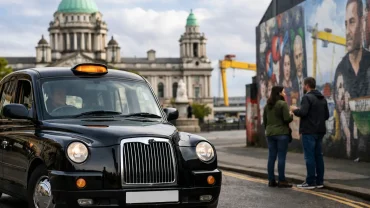
If you visit the peace lines as part of a black taxi tour, you can usually expect to see key murals, memorial gardens, significant interface points and neighbourhoods central to the story of the Troubles. The experience is often far more personal than people anticipate. The strongest tours do not feel scripted. They feel like a conversation with someone who understands the place from the inside.
That matters especially for first-time visitors, cruise passengers with limited time, or anyone who wants a clear introduction without spending hours trying to piece the story together alone. Belfast Black Taxi Tour, for example, is built around that kind of balanced, firsthand storytelling, which helps turn a difficult subject into something accessible and human.
How to visit respectfully
The peace lines are among the most significant places you can visit in Belfast, but they are not open-air theatre. People live here. Children walk to school here. Families carry memories here.
The best approach is straightforward. Be curious, but not intrusive. Take photographs where appropriate, but stay aware of your surroundings. Listen more than you speak. Avoid treating murals, memorials or interfaces as backdrops for novelty. And if a guide explains the sensitivities of a particular area, take that seriously.
Visitors sometimes worry about saying the wrong thing. In truth, most local people respond well to genuine interest shown with basic respect. You do not need to arrive with expert knowledge. You just need to arrive willing to learn.
Are the peace lines still necessary?
This is one of the hardest questions in any guide to Belfast peace lines, and there is no neat answer. Belfast has changed dramatically since the Good Friday Agreement. The city is safer, more open and more confident than it was during the darkest years of the Troubles. Yet peace-building does not erase fear overnight, and it does not remove generations of mistrust with a single political settlement.
Some residents support the long-term removal of peace lines, seeing them as barriers to shared space and a reminder of division. Others feel they should remain until relationships between communities are stronger and more secure. Views can vary street by street.
That is why these structures remain so revealing. They show both how far Belfast has come and where the work is still unfinished. They are evidence of peace, but also evidence of what peace still has to manage.
Why the peace lines matter to visitors
If you want only postcard Belfast, the peace lines may feel uncomfortable. That is precisely why they matter. They offer a direct, unvarnished way into the city’s recent history and the people shaped by it.
For many visitors, this becomes the most memorable part of their trip – not because it is easy, but because it feels real. You come away with more than dates and political terms. You come away with a sense of how ordinary streets became part of an extraordinary conflict, and how communities continue to carry both pain and pride.
Belfast is not defined solely by its past, but it does not hide from it either. The peace lines are part of that honesty. Seen properly, they help visitors understand not just division, but the daily effort involved in building a better future.
If you go, go with time, good guidance and an open mind. Belfast will meet you with the truth of its history, and often with a bit of local craic too.
Comment (0)