
A red-brick prison on the Crumlin Road can tell you more about Belfast than many grand monuments. Crumlin Road Gaol history is not simply the story of a Victorian jail. It is a story of authority, poverty, punishment, political conflict and a city learning to face difficult memories with honesty.
Known locally as the Crum, the gaol stands opposite the old courthouse in north Belfast. Its imposing façade was designed to intimidate, and for generations it did. Yet behind those walls are thousands of individual lives: people convicted of ordinary crimes, women and children caught in a harsh system, political prisoners from different traditions, prison officers and families waiting outside the gates.
For visitors keen to understand Belfast beyond the postcards, it is one of the city’s most powerful places to pause, listen and ask better questions.
Crumlin Road Gaol history begins in Victorian Belfast
Crumlin Road Gaol was designed by the renowned Belfast architect Sir Charles Lanyon and opened in 1846. Belfast was expanding rapidly through industry, shipbuilding and linen, but prosperity sat alongside overcrowding, hardship and severe social inequality. The gaol was built to serve the growing city and the wider county of Antrim, replacing an earlier prison that had become inadequate.
Its design followed the Victorian belief that surveillance and isolation could reform prisoners. The central governor’s area gave staff sightlines down four wings, while individual cells limited contact between inmates. It was a formidable piece of architecture, but it was also a working institution shaped by the strict values of its era.
Conditions could be bleak. Prisoners undertook hard labour, including work in the prison’s workshops, and discipline was severe. The gaol held men, women and children, a fact that gives modern visitors a clear sense of how differently justice and childhood were understood in the nineteenth century. A visit is not meant to romanticise that past. It brings its human cost into focus.
The tunnel beneath the road
One of the gaol’s most memorable features is the underground tunnel linking it to the former Crumlin Road Courthouse. Prisoners could be taken from their cells to court without crossing the busy road above or appearing before the public. The passage is a striking reminder of how closely the systems of arrest, trial and imprisonment once operated here.
For many visitors, walking through it creates an immediate connection with the people who made that same journey under far less certain circumstances. Some faced minor charges. Others were about to hear verdicts that would change their lives forever.
Execution, escape and the weight of the place
Seventeen men were executed at Crumlin Road Gaol between 1854 and 1961. The execution chamber and condemned cell remain among its most sobering spaces. They deserve to be approached with respect, not as a spectacle. These rooms speak to an era when capital punishment was part of the criminal justice system, and when the state exercised its power in the most final way possible.
The last execution took place in 1961, when Robert McGladdery was hanged for murder. It came only a few years before the end of capital punishment for murder in the United Kingdom. Standing in the execution area, visitors often find that the historical facts become more personal. The details of machinery and procedure matter less than the reality that a human life ended there.
There were also escapes and attempted escapes over the gaol’s long operational life. Their stories have helped create the Crum’s formidable reputation, but they should not distract from the wider picture. This was not a museum built as a theatrical set. It was an active prison for 150 years, and its walls absorbed fear, boredom, grief, defiance and routine in equal measure.
The Troubles and a divided city
No account of Crumlin Road Gaol history is complete without addressing the Troubles. From the late 1960s onwards, the prison became deeply connected to Northern Ireland’s conflict. It held Republican and Loyalist prisoners, as well as people accused or convicted of non-political offences. The period placed enormous pressure on the prison, its officers and the communities beyond its gates.
This is where context matters. The Troubles cannot be reduced to a single narrative, a scorecard of suffering or a row of labels. Belfast families experienced violence, bereavement and fear in different ways, often depending on where they lived, their background and their political identity. The gaol sits within that complicated history.
Political imprisonment was a fiercely contested issue. Prisoner status, security policy, protests and prison conditions were all bound up with the wider conflict outside. For some, imprisonment was seen through the lens of political struggle. For others, it represented the consequences of paramilitary violence. Prison staff, meanwhile, worked in an environment marked by real danger and intense tension.
A thoughtful visit should leave room for these overlapping truths. That does not mean avoiding difficult subjects or pretending every experience was the same. It means listening carefully, using credible sources and recognising the humanity of everyone affected.
Why local interpretation makes a difference
A building can show you the cells, gates and tunnel. A knowledgeable local guide can explain how the prison relates to the streets around it, the old courthouse, Belfast’s segregated neighbourhoods and the peace process that followed the conflict.
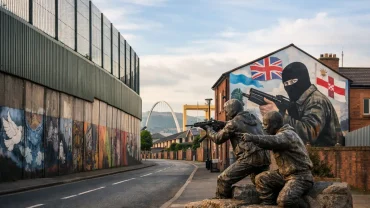
That wider perspective is especially valuable for first-time visitors. Crumlin Road Gaol is close to the peace lines, murals and communities that carry their own memories of the Troubles. Seen together, these places reveal that Belfast’s history is not confined to one institution or one side of the city.
The best interpretation is balanced without being bland. It acknowledges pain, explains political realities and makes space for authentic stories from people who lived through the period. That is how difficult heritage can become meaningful rather than overwhelming.
Closure, renewal and what the gaol means now
Crumlin Road Gaol closed as a working prison in 1996. Its closure reflected changing prison arrangements in Northern Ireland, but it also marked the end of an institution that had shaped north Belfast for generations. For a time, the future of the building was uncertain.
Its later restoration and reopening as a visitor attraction gave Belfast a chance to preserve a significant part of its built heritage. That decision was not without complexity. Former prisons can attract curiosity, and there is always a risk of turning suffering into entertainment. The strongest approach is to treat the site as a place of education and remembrance, while still allowing visitors to engage with its dramatic architecture and remarkable stories.
Today, the Crum is part of a more confident Belfast: a city that does not hide from its past, but is not trapped by it either. Visitors can leave with a clearer understanding of how Victorian justice, political conflict and community life have shaped the city they see around them.
Making your visit more meaningful
Allow time to take in the site rather than rushing through it. The prison experience can be emotionally heavy, particularly around the execution chamber and the accounts of the Troubles. It depends on your interests and available time, but pairing the gaol with a guided journey through west and north Belfast often provides the context that signs and displays alone cannot offer.
For travellers who want that fuller picture, Belfast Black Taxi Tour can place the Crum within the living landscape of the city, from the peace walls to the political murals and the communities on either side. Private touring also gives you room to ask questions at your own pace, which matters when the subject is personal as well as historical.
Crumlin Road Gaol is not a place that asks for easy reactions. Walk through its gates with curiosity and respect, and you will come away with something more valuable than a photograph: a deeper sense of Belfast, its scars, its resilience and its continuing capacity for change.


Comment (0)