
Belfast’s conflict landmarks are not a museum trail with neat answers. They are places where history is written on gable walls, remembered in gardens and still felt in the streets where people live. This guide to Belfast conflict landmarks will help you see the city with context, respect and a clearer understanding of the human stories behind The Troubles.
Why Belfast’s conflict landmarks need context
The period commonly known as The Troubles lasted from the late 1960s until the Good Friday Agreement of 1998, although its roots reach much further back. It involved constitutional dispute, identity, civil rights, discrimination, paramilitary violence and the actions of the British state. Above all, it affected ordinary people in every community.
That is why a painted wall or a memorial plaque should never be treated as a quick photo stop. Murals can express pride, grief, political allegiance, calls for justice or hopes for peace. Memorials often name neighbours, relatives and friends. A landmark may mean something deeply personal to the people who pass it every day.
A good visit does not require you to arrive with all the answers. It does ask you to listen carefully, avoid assumptions and recognise that different communities experienced the same decades in different ways. Belfast is also a modern, welcoming and creative city, and its progress makes most sense when visitors understand what came before.
How to use this guide to Belfast conflict landmarks
West Belfast is the essential starting point. The Falls Road and Shankill Road sit close together geographically, yet their murals, memorials and community spaces reflect different traditions and political perspectives. Between them are peace lines – physical barriers that reveal both the legacy of division and the complex realities of post-conflict life.
Give this part of the city time. A rushed walk can show you the surface, but the detail matters: the date on a memorial, the language used on a mural, the location of a gate or the story behind a painted image. Murals also change. Some are preserved for years, while others are replaced as community conversations and priorities evolve.
These areas are residential neighbourhoods, not open-air exhibits. Keep noise low, do not enter private property for photographs, and be mindful around memorial events, schools, churches and local shops. The warm Belfast welcome is real, but respect is part of receiving it.
West Belfast landmarks that tell the story
The Falls Road and the International Wall
The Falls Road is strongly associated with the nationalist and republican community. Its best-known feature is the International Wall, a changing collection of murals that has addressed local history alongside international struggles, civil rights, solidarity and peace.
Visitors will also encounter memorials connected to republican organisations and individuals killed during the conflict. These can be emotionally powerful, particularly when guides explain the personal stories behind the names rather than reducing them to political labels.
The area around Divis Street and the lower Falls provides a useful introduction to the civil rights era and the early years of The Troubles. Look beyond the artwork itself. Street names, community centres and commemorative spaces all add layers to the story.
The Shankill Road
Across the peace line, the Shankill Road is a key location for understanding the unionist and loyalist community’s experience. Murals here have traditionally commemorated loyalist organisations, British military heritage and those from the area who died during The Troubles. As on the Falls, the visual language is direct, proud and often deeply personal.
It is tempting to treat the Falls and Shankill as opposing galleries. That misses the point. Both roads carry memories of loss, fear, identity and resilience. Seeing them together gives visitors a more balanced perspective on how close communities could be physically while remaining divided by politics, violence and mistrust.
Ask questions, but ask them with care. A knowledgeable local guide can explain why an image, symbol or colour carries meaning, and can place it within the wider history without turning a complex past into a simple two-sided story.
The peace lines at Cupar Way and Lanark Way
The peace lines are among Belfast’s most striking conflict landmarks. Built and extended during periods of heightened tension, these barriers separate parts of nationalist and unionist neighbourhoods. They are a visible reminder that peace is not just an agreement on paper – it is something communities continue to build in everyday life.
The wall at Cupar Way is especially well known. Visitors often leave messages of hope on its panels, a tradition that reflects a genuine wish for peace. It is worth pausing before adding your own. Read what is already there, consider the setting, and remember that the wall is beside people’s homes.
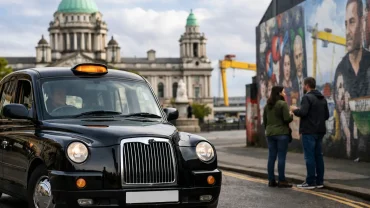
Some gates in the peace lines are open during the day and closed at particular times. Arrangements can change, so it is sensible not to build a self-guided route around crossing points without checking locally. A private black taxi tour removes that uncertainty and allows time for the stories that make the walls understandable.
Other Belfast sites that add depth
Crumlin Road Gaol and the courthouse
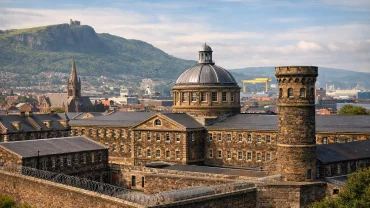
Crumlin Road Gaol, known locally as the Crum, offers another important perspective. Opened in the nineteenth century, the prison held people from across Belfast’s social and political divides, including prisoners connected to The Troubles. Its imposing Victorian structure, the former tunnel towards the courthouse and the surrounding streets make clear that conflict history was never confined to one part of the city.
The site can be confronting. It raises difficult questions about imprisonment, justice, punishment and political status. That discomfort is part of its value. Belfast’s past should not be polished into something easy simply because visitors are on holiday.
Bombay Street and the Clonard area
Bombay Street, close to the lower Falls, is associated with the violence of August 1969, when homes were burned and families were forced to flee. The surrounding Clonard area helps visitors understand how rapidly insecurity reshaped ordinary streets at the beginning of The Troubles.
This is not a place for dramatic re-enactment. It is a place to reflect on displacement, fear and the long shadow such events cast over families. Local testimony brings particular weight here, because the history is remembered as lived experience rather than distant fact.
Visiting with respect and perspective
The most meaningful way to see Belfast is to resist the urge to choose a side based on a few slogans or murals. The city’s conflict history contains competing narratives, real pain and unresolved questions. Listening to more than one perspective is not avoiding history – it is taking it seriously.
Photography is generally welcome at major murals and peace-wall locations, but good judgement matters. Do not photograph residents without permission, block pavements, climb barriers or treat memorials as props. If a guide suggests a quieter approach at a particular stop, follow their lead.
Language matters too. Terms such as nationalist, unionist, republican and loyalist describe political traditions, but individuals hold a wide range of views. Avoid assuming someone’s identity from their postcode, accent, flag or religion. Belfast people are more nuanced than the labels visitors sometimes bring with them.
For many travellers, a guided private tour is the best choice because it combines convenience with interpretation. Belfast Black Taxi Tour is jointly owned across communities, and its guides bring authentic stories and a balanced local perspective to places that can otherwise be difficult to read. You will see the landmarks, but more importantly, understand why they matter.
Make room for Belfast as it is now
After visiting conflict landmarks, spend time in the city centre, enjoy the craic in a local pub, or take in Belfast’s food, music and waterfront. Doing so is not turning away from history. It is recognising what generations of people have worked to protect and rebuild.
The most lasting memory should be neither a mural nor a wall. Let it be the understanding that Belfast’s story belongs to real people, and that every respectful conversation about its past leaves a little more room for its future.
Comment (0)