
Stand on the Falls Road in the morning and the Shankill in the afternoon, and you quickly understand that Belfast is not a city you read at a distance. Its politics are written on walls, kerbstones, memorial gardens and street names. This guide to Belfast political history is for visitors who want more than headlines. It is for people who want to understand how a relatively small city came to sit at the heart of one of Europe’s most complex modern conflicts.
Belfast rewards curiosity, but it also asks for care. The story here is not neat, and anyone who tells you otherwise is giving you the polished version. To understand the city properly, you need to hold together industry and empire, class and religion, identity and territory, memory and loss.
Why Belfast’s political history matters
Belfast is the capital of Northern Ireland, but politically it has long been more than an administrative centre. It became a place where British and Irish identities hardened, where questions of power and belonging turned local streets into symbols, and where ordinary families lived the consequences of decisions made in Westminster, Dublin and Stormont.
For visitors, the challenge is often this: the names come quickly – unionism, nationalism, loyalism, republicanism, partition, power-sharing – but the meaning behind them can feel blurred. Broadly speaking, unionists have supported Northern Ireland remaining part of the United Kingdom, while nationalists have sought a united Ireland. Loyalism and republicanism are related traditions, often more militant in tone and history. Those distinctions matter, though in real life people’s identities are often more layered than the labels suggest.
Belfast before partition
Any serious guide to Belfast political history has to start before The Troubles. In the nineteenth century, Belfast grew fast on the back of linen, ropeworks, engineering and shipbuilding. It was one of the great industrial cities of these islands, and prosperity shaped its politics.
Much of that industrial wealth was tied to the Union with Britain. Many Protestants in Belfast saw their future in the United Kingdom and feared that Irish self-government would threaten both their economic interests and their British identity. At the same time, many Catholics, who often faced discrimination in housing, employment and political power, were more likely to support Irish nationalism.
This was never only about religion. Religion often marked community background, but the deeper issue was political allegiance and national identity. Protestant did not simply mean unionist, and Catholic did not automatically mean nationalist, but those patterns became strong enough to define much of public life.
By the late nineteenth and early twentieth centuries, tensions over Home Rule – limited self-government for Ireland within the UK – sharpened dramatically. Belfast became a centre of unionist resistance. The signing of the Ulster Covenant in 1912 and the mobilisation of the Ulster Volunteer Force showed just how far many unionists were prepared to go to oppose being governed from Dublin.
Partition and the new Northern Ireland
Partition came in 1921, dividing the island and creating Northern Ireland as a six-county entity within the United Kingdom. Belfast became its capital. For unionists, this secured their position. For nationalists, especially those living in the new Northern Ireland, it often felt like being cut off inside a state they had not wanted.
Stormont, the new parliament at Parliament Buildings, represented self-government for Northern Ireland, but power was overwhelmingly held by unionists for decades. Nationalists regularly argued that the state was structured to preserve a Protestant and unionist majority through electoral boundaries, housing allocation and public employment patterns.
That does not mean every part of government worked in the same way or that every unionist politician acted with the same intent. Still, for many Catholics, the lived experience was one of exclusion. That sense of unfairness sits at the root of what came later.
Civil rights and the road to conflict
In the 1960s, inspired in part by the civil rights movement in the United States, campaigners in Northern Ireland began calling for reform. Their demands were basic and democratic: fair voting, fair housing allocation, an end to discrimination and accountable policing.
What followed exposed how fragile Northern Ireland already was. Civil rights marches were met at times with hostility and violence. Tensions between marchers, police and counter-protesters escalated. In Belfast, old divisions became newly combustible.
The late 1960s saw serious disorder, the arrival of British troops in 1969 and the beginning of what became known as The Troubles. For some communities, soldiers were first seen as protection. That changed over time, especially in nationalist areas, as relationships deteriorated and violence intensified.
The Troubles in Belfast
From the late 1960s until the 1998 Good Friday Agreement, Belfast was one of the central stages of The Troubles. Republican paramilitaries, most notably the Provisional IRA, fought to end British rule in Northern Ireland and achieve Irish unity. Loyalist paramilitaries claimed to defend the Union and Protestant communities. The British Army and the Royal Ulster Constabulary were major forces on the ground, and the state itself was deeply contested.
This was not a simple two-sided conflict. It involved paramilitary campaigns, state security operations, political negotiations, community trauma and countless civilians trying to get on with life under extraordinary pressure. Bombings, shootings, punishment attacks, internment, prison protests and sectarian killings became part of daily reality.
Some places in Belfast carry that history with particular force. The Falls Road and Shankill Road are internationally known because they became shorthand for republican and loyalist communities, but they are also ordinary neighbourhoods where people raised families, went to school, worked, grieved and endured. The peace lines, first built as temporary barriers, still stand in parts of the city. Their continued presence tells you something uncomfortable but honest: peace and separation have often existed side by side.
Murals, memory and contested space
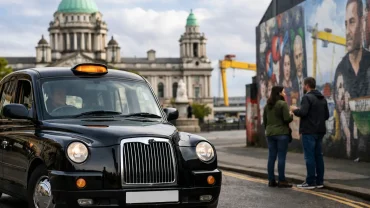
Visitors are often drawn to Belfast’s political murals, and rightly so. They are striking, but they are not just street art. They are public statements of identity, remembrance and power.
Republican murals have often commemorated hunger strikers, prisoners, international solidarity and the aspiration for Irish unity. Loyalist murals have highlighted regimental history, paramilitary symbolism, royal allegiance and local sacrifice. In recent years, some murals have shifted towards broader cultural themes, but many still sit close to live political feeling.
The same is true of memorials and flags. What one person sees as heritage, another may experience as intimidation. That is one reason Belfast is best understood with context rather than quick judgement. The city’s visual landscape is layered, and it changes from street to street.
The peace process and the Good Friday Agreement
The Good Friday Agreement of 1998 marked a profound turning point. It did not erase division, but it created a political framework that made a different future possible. The agreement confirmed that Northern Ireland would remain part of the UK unless a majority voted otherwise, while also recognising the legitimacy of Irish nationalist aspirations. It established power-sharing institutions and embedded principles of consent, equality and cooperation.
That balance was crucial. Neither side got everything it wanted, and that was precisely the point. Peace here was not built on total victory. It was built on compromise, however frustrating and imperfect.
Even so, the agreement did not end argument. Disputes over policing, legacy, parades, language, flags and Brexit have all shown how history continues to shape the present. Belfast today is far safer and more open than during the darkest years, but its politics still carry old fault lines.
Belfast political history today
Modern Belfast is a city of energy and contradiction. New hotels, restaurants, universities and cultural spaces sit alongside interfaces where communities remain physically divided. Younger people may have grown up after the ceasefires, yet they still inherit stories, loyalties and anxieties from earlier generations.
That is why political history here never feels entirely finished. Questions about identity remain active. Is Northern Ireland primarily British, Irish, both or something else again? Should difficult memorials be preserved, reinterpreted or removed? How should a post-conflict city welcome visitors without turning pain into performance? There are no easy answers, and anyone offering a tidy script is skipping the hard part.
For travellers, that complexity is exactly why Belfast is so compelling. Done well, learning about its past does not reduce the city to conflict. It does the opposite. It reveals the humour, resilience and candour of the people who lived through it.
How to understand this history as a visitor
Read before you arrive if you can, but accept that books only take you so far. Belfast is a city where local knowledge matters. A mural, a gate, a police station or a row of terraced houses can hold meanings that are invisible to outsiders.
It also helps to resist the urge to pick a tidy hero-and-villain version of events. People here experienced the same decades very differently. Some families lost loved ones to republican violence, others to loyalist violence, others to state actions. Many suffered more than one kind of loss. Balanced understanding does not mean flattening moral questions. It means being honest about the full human cost.
That is one reason visitors often find a guided experience so valuable. Hearing authentic stories from people who lived through these years gives shape to places that might otherwise look like ordinary streets. A company such as Belfast Black Taxi Tour can provide that balanced local perspective in a way that is grounded, respectful and far more human than a textbook.
Belfast does not ask you to arrive as an expert. It asks you to pay attention. If you do, you will leave with more than dates and political terms. You will leave with a clearer sense of how history lives on in the present, and why this city, with all its scars and all its craic, stays with people long after the journey home.
Comment (0)