
You can stand on the Falls Road in the morning, listen to one story of Belfast, then turn onto the Shankill and hear another version of the same decades. That is exactly why a catholic and protestant Belfast tour matters. This city is best understood through lived experience, local context and the kind of conversation that goes beyond dates on a plaque.
For many visitors, Belfast is one of the most compelling places in these islands because its history is still visible on the streets. Murals are not tucked away in a museum. Peace lines still stand. Names, neighbourhoods and memorials carry memory in a way few cities do. If you want to understand what happened here during The Troubles, and how Belfast has changed since, a balanced private tour is not an extra. It is the difference between seeing sites and actually understanding them.
What makes a catholic and protestant Belfast tour different
The phrase can sound simple, but the experience should never be simplistic. A strong catholic and protestant Belfast tour does not reduce the city to two neat sides. Belfast is more layered than that. What it should do is give you access to viewpoints shaped by communities that lived through conflict in very different ways.
That matters because The Troubles were not an abstract political dispute. They affected ordinary streets, schools, workplaces and families. Visitors often arrive knowing a few headline terms – IRA, loyalism, British Army, Good Friday Agreement – but struggle to place them in the real geography of the city. Once you travel through West Belfast with a guide who knows the ground and the history, those terms stop being distant and start making sense.
The best tours are balanced without becoming vague. They are direct about violence and loss, but they also explain identity, culture, resilience and the long work of peacebuilding. That balance is especially valuable if this is your first visit and you want clarity rather than confusion.
Seeing Belfast through both communities
A meaningful tour usually includes the Falls Road and the Shankill Road because these areas are central to Belfast’s modern story. On the Falls, republican murals, memorial gardens and community landmarks help explain Irish nationalism, civil rights, internment and the experience of Catholic communities during the conflict. On the Shankill, loyalist murals and memorials open up discussions about unionism, British identity, paramilitary influence and the fears that shaped Protestant communities.
The point is not to force symmetry where it does not exist. Every area has its own history, symbols and political language. A knowledgeable local guide helps visitors understand those differences without sensationalising them. You are not there to consume conflict as entertainment. You are there to hear authentic stories and leave with a clearer sense of how Belfast became the city it is today.
The peace walls are often one of the most striking stops. For first-time visitors, the surprise is not only that they still exist, but that they remain part of daily life. Seeing these barriers in person changes your understanding immediately. They are physical reminders that peace is real, but still evolving.
Why a black taxi tour suits this history
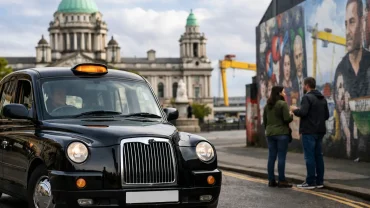
Belfast’s political history is not best told from the top deck of a large coach rolling past at speed. It needs space for questions, context and moments where the guide can stop, point something out and explain why one mural matters more than another. That is where a private black taxi tour comes into its own.
The format is personal. You can ask what feels too basic to ask elsewhere. You can pause at memorials, hear the local meaning behind a street name and understand why two communities can remember the same event differently. If you are travelling as a couple, a family or a small group, that private setting often makes difficult history much easier to absorb.
There is also a practical advantage. Belfast weather can turn quickly, and the black cab keeps the experience comfortable while still letting you step out where it counts. For cruise passengers or short-stay visitors, direct pickup and a well-planned route make a real difference. You can cover the key locations efficiently without the tour feeling rushed.
Balanced perspective is not a slogan
Anyone can claim balance. In Belfast, visitors are right to look closer. A balanced perspective does not mean flattening the past or pretending every action carried the same weight. It means guiding people through a sensitive subject honestly, respectfully and with enough local understanding to explain why memories remain strong.
That is why lived experience matters. Guides who grew up here do more than repeat a script. They know the atmosphere that surrounded checkpoints, marches, funerals and ceasefires. They understand how certain places felt at different times, and why older residents may still speak about them with emotion. That kind of knowledge cannot be copied from a textbook.
It also helps visitors avoid common misunderstandings. Belfast is not frozen in conflict. Nor is it a city that has simply moved on and forgotten. Both ideas miss the truth. The city is vibrant, welcoming and full of energy, but the past still shapes politics, neighbourhoods and identity. A good guide makes room for both realities.
What you will actually learn on the tour
Most visitors come away with far more than a timeline of The Troubles. You begin to understand how Belfast was built through industry, class, religion and politics. You see how segregation developed, why certain flashpoints mattered and how local communities responded over time.
Murals are one of the most visible parts of that story, but they are not just photo stops. Some are acts of remembrance. Some are political statements. Some show how communities want to represent themselves now, not only what they endured in the past. Without explanation, it is easy to miss those distinctions.
You will also hear about the peace process in a way that feels grounded rather than ceremonial. Agreements matter, of course, but so do smaller everyday changes – how people move through the city, where children go to school, which interfaces remain sensitive and where shared spaces have grown. That is often the part visitors remember most, because it shows Belfast not as a headline but as a living place.
Is this tour right for every visitor?
For most people with even a modest interest in history or politics, yes. If you want the polished version of Belfast with no difficult edges, this may not be your favourite outing. But if you are curious, open-minded and looking for something more meaningful than standard sightseeing, it is often the highlight of the trip.
Families with older children and teenagers usually find it especially worthwhile because the city itself becomes the classroom. Couples often appreciate the private pace and chance to ask questions freely. Cruise guests and short-break travellers value how much understanding they can gain in a relatively short time.
The only real trade-off is emotional weight. Some stories are hard to hear, and they should be. Yet that seriousness is part of what makes the experience memorable. In the right hands, the tour is never heavy for the sake of it. There is room for warmth, local character and a bit of Belfast craic along the way.
Choosing the right catholic and protestant Belfast tour
Not every tour offers the same depth. If balance and authenticity matter to you, look for guides with a genuine connection to the history, not just a list of stops. The best experiences are usually private or small-group, with time built in for discussion rather than a hurried run-through.
It is also worth checking whether the company frames the tour with respect. Belfast’s past draws interest from around the world, but it deserves more than shock value. A professional guide should be clear, informed and comfortable handling sensitive questions without drifting into point-scoring.
This is one reason Belfast Black Taxi Tour stands out. The shared ownership between Catholic and Protestant partners says something important before the journey even begins. It tells visitors that balanced perspective here is not a marketing line. It is built into the way the experience is designed and delivered.
If Belfast is on your itinerary, give yourself time to understand it properly. The city rewards curiosity. Its history is difficult, human, often misunderstood and absolutely worth hearing from the people who know it best. Book the kind of tour that leaves you with more than photographs – one that helps Belfast stay with you long after you have gone home.

Comment (0)