
You can see Belfast from the top deck of a bus and tick off the landmarks. Or you can sit in a black cab with someone who lived the history, ask the awkward questions, and hear the city explained street by street. That is really what sits at the heart of the black taxi versus bus tour decision.
For some visitors, a bus tour is perfectly fine. It gives a broad overview, helps with orientation, and can suit a shorter stop in the city. But if your main reason for coming to Belfast is to understand its story – especially The Troubles, the peace walls, the murals, and the people behind them – then the experience changes completely when it becomes personal.
Black taxi versus bus tour: what is the real difference?
On paper, both options might seem to cover similar ground. You will likely pass major sights, hear commentary, and come away with photographs. In practice, they are very different kinds of day out.
A bus tour is built for scale. It moves larger numbers of people on a fixed route and usually works to a set script. That can be useful if you want a simple introduction to the city centre and a general sense of where things are. It is often a straightforward choice for travellers who are budget-conscious or who prefer a lighter-touch sightseeing experience.
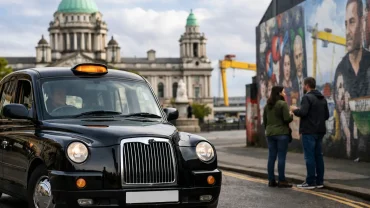
A black taxi tour is built around the guide, the conversation, and the ability to stop where the story matters. In Belfast, that matters more than in many cities. This is not just a place of architecture and famous buildings. It is a city shaped by memory, identity, conflict, resilience, and change. You can drive past a peace line on a bus and hear a summary. In a black cab, you can stand beside it, see the gates up close, read the messages on the walls, and ask what life was really like on either side.
That difference is not cosmetic. It changes what you understand.
Why a black taxi tour suits Belfast especially well
Belfast is compact, but its history is layered. Some of the most meaningful places are not grand landmarks in the usual tourist sense. They are streets, memorials, murals, interfaces, former flashpoints, and neighbourhoods where lived experience still carries weight.
That is where a private black taxi tour comes into its own. The guide is not simply reciting dates. A strong local guide gives context – why a mural is there, how an area changed over time, what the Good Friday Agreement meant on the ground, why language still matters, and how communities remember the same period differently.
For many visitors, that balanced perspective is the reason they book. The history of Belfast deserves more than a one-size-fits-all commentary. It needs care, accuracy, and humanity. When guides have lived through the years they are describing, the city stops feeling abstract. It becomes real.
A bus can tell you where The Troubles happened. A black taxi tour can help you understand how people lived through them.
The value of asking questions
One of the biggest advantages of a black taxi tour is simple – you can talk. Visitors often arrive with genuine curiosity but also a bit of uncertainty. They do not want to ask the wrong thing, or they are unsure how to make sense of what they are seeing.
In a private setting, that changes. You can ask about republican and loyalist areas, segregation, policing, paramilitaries, peace lines, housing, education, and how modern Belfast feels today. You can go beyond the script. You can follow the thread of what interests you.
That sort of exchange is difficult on a bus, where time is tighter and commentary must suit everyone at once.
Access and flexibility
There is also the practical side. Black taxi tours can pull in close to key sites, pause for photographs, and adjust the pacing to suit the group. If you want a few extra minutes at the murals or a stop at Crumlin Road Gaol, that flexibility matters. If you are travelling with family, older relatives, or a small private group, the comfort of direct pickup and a tailored route often makes the day much easier.
Bus tours are less adaptable by design. They need to keep moving and stick to timetable points. That is not a flaw – it is just the nature of the format.
When a bus tour may be the better option
There are cases where a bus tour makes very good sense. If you are in Belfast for only a few hours and want a general city overview, it can be a practical way to get your bearings. If your interests are broad rather than deeply historical, a bus may cover enough ground to suit you.
It can also work well for travellers who like hop-on hop-off flexibility or who are planning to spend the rest of the day exploring independently. If budget is the main deciding factor, bus tours are usually the lower-cost option.
There is no need to pretend otherwise. A bus tour has its place. It can be useful, convenient, and enjoyable. The question is not whether buses are bad. The question is what kind of experience you want from Belfast.
If you are looking for a light city introduction, a bus may do the job. If you want depth, nuance, and a proper conversation with someone local, it is rarely the stronger choice.
Black taxi versus bus tour for history travellers
For visitors drawn to Belfast because of its political history, the black taxi versus bus tour comparison tends to become clearer quite quickly.
The murals are a good example. Seen from a bus, they are striking images. Seen with a guide who can explain their symbolism, their chronology, their community context, and how they have changed over time, they become historical documents. The same goes for the peace walls, memorial gardens, and interface areas. These are not just places to photograph. They are places to interpret carefully.
History travellers usually want more than names and dates. They want perspective. They want to know how the conflict shaped ordinary life, how people now live with the legacy, and what progress looks like in a city that is still evolving. That is why guided black taxi tours continue to resonate so strongly with visitors who want authenticity rather than a surface-level account.
The best tours also make space for contradiction. Belfast is not neatly explained in a single narrative. A credible guide will not flatten the city into easy slogans. They will help you understand complexity without making it feel inaccessible.
Comfort, privacy and pace
There is another factor people often underestimate until they arrive – how much the format affects comfort. On a busy bus, you are sharing the experience with strangers, listening at the pace of the vehicle, and fitting yourself into the group rhythm. That suits some people perfectly well.
A black taxi tour feels more personal from the start. You are in a smaller space, the pace is calmer, and the attention is on your group. For couples, families, and cruise passengers with limited time, that can make a real difference. Direct pickup and drop-off remove the faff. You spend less time figuring out logistics and more time actually seeing Belfast.
Privacy matters too. Not everyone wants to discuss difficult history in front of a full bus. Some travellers appreciate having room for reflection, questions, and quieter moments, particularly when the subject matter is emotional.
So which should you choose?
It depends on what you want Belfast to be for you.
If you want a quick city spin, broad landmarks, and a lower-cost overview, a bus tour may suit. You will see plenty and it may be all you need.
If you want a richer understanding of the city, a close-up look at places tied to The Troubles, and a balanced local voice to guide you through it, a black taxi tour is usually the more rewarding option. That is especially true if this is your first visit, if history is your main interest, or if you simply prefer your travel experiences to feel human rather than scripted.
At Belfast Black Taxi Tour, that is exactly the point – not just showing visitors the city, but helping them understand it through authentic stories, lived experience, and a respectful, balanced perspective.
Belfast is a city that stays with people. Choose the kind of tour that lets you feel why.


Comment (0)