
A mural can tell you who was honoured, who was feared, and what a street once lived through – but only if someone can read it with you. That is exactly how black taxi tours explain Belfast history: not as a dry timeline, but as a lived story told in the very places where it happened.
For many visitors, Belfast raises immediate questions. What were The Troubles really about? Why are there peace walls in a modern European city? How can two communities remember the same events so differently? These are fair questions, and they deserve more than a quick stop for photographs. A black taxi tour gives you context, local knowledge and the human detail that turns headlines into understanding.
Why a black taxi tour works so well in Belfast
Belfast is a city where history is written into neighbourhoods. In some places, you can travel only a few minutes and move between very different political traditions, symbols and memories. If you tried to piece that together on your own, you might see the murals and the gates, but you would miss the meaning.
That is where the format matters. A black taxi tour is private, personal and flexible. You are not straining to hear a guide at the back of a large coach, and you are not left trying to decode a sensitive past from a plaque on a wall. You are travelling with someone who knows the roads, knows the stories, and understands where explanation needs care.
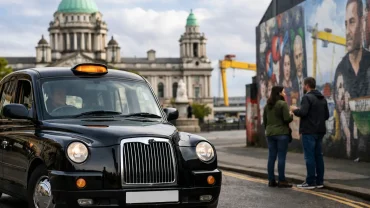
There is also something fitting about seeing Belfast this way. The black cab is part of the city’s modern identity. It moves easily through key areas connected to conflict history, and it allows the tour to feel grounded in local life rather than staged for tourists.
How black taxi tours explain Belfast history on the ground
The real strength of these tours is that they connect places to people. Belfast’s history can sound complicated when reduced to dates, agreements and political terms. On the ground, it becomes clearer. You begin to understand how segregation affected daily routines, why certain streets became flashpoints, and how identity was expressed through flags, kerbstones and public art.
A good guide will usually begin by setting out the broad background – partition, civil rights, the eruption of violence in the late 1960s, and the decades that followed. But the best tours do not stop there. They explain how those events shaped ordinary lives. Where children played. Which roads people avoided. How communities experienced security, fear, loss and resilience.
That balance matters. Belfast history is not one neat, shared narrative. It includes competing loyalties, conflicting memories and very real pain on all sides. A credible black taxi tour does not flatten those differences. It helps visitors understand them without turning the experience into a shouting match or a history lecture.
Murals as public history
The murals are often what visitors remember first. They are striking, political and deeply local. Yet they are also easy to misread if you do not know the background.
On a black taxi tour, murals become more than street art. They are explained as public statements – expressions of identity, remembrance, protest and change. Some commemorate paramilitary figures or political prisoners. Others honour civil rights activists, victims, cultural icons or international causes that local communities felt connected to.
A guide can point out what has changed over time as well. Not every mural tells the same kind of story it did twenty years ago. In some areas, the imagery has shifted from conflict to community pride, culture, sport or peace-building. That change says a great deal about Belfast today.
The peace lines and what they still mean
Few sights surprise visitors more than the peace lines. For those arriving in Belfast for the first time, it can be startling to find large barriers and gated interfaces still standing. Seen without explanation, they can feel impossible to place in the present.
On tour, those walls are given proper context. You learn why they were erected, what fears they responded to, and why some residents have valued them even while supporting a more shared future. This is one of the clearest examples of why local interpretation matters. The peace lines are not just relics. They are part of a living conversation about safety, trust and what peace actually looks like on the ground.
Firsthand stories give the history its human weight
One of the biggest differences between a black taxi tour and a standard sightseeing experience is the voice telling the story. Visitors are often looking for something more authentic than a rehearsed script. They want to hear from people who understand Belfast because they lived it.
That firsthand perspective changes everything. It does not mean every guide has identical views, and it should not. What it does mean is that the history is carried with realism. When a guide describes army checkpoints, bomb scares, daily tension or the relief brought by peace, you hear the weight of lived experience behind the facts.
There is an important trade-off here. Personal memory can add depth, but good guiding also requires discipline. The strongest tours combine firsthand insight with balance. They do not pretend the past was simple, and they do not ask visitors to pick a side. Instead, they help people grasp why history is still emotionally charged while showing how far the city has come.
That balanced perspective matters even more when the subject is The Troubles. Visitors want honesty, but they also want to feel they are hearing a fair account. For that reason, tours led through a shared-heritage approach can be especially powerful. Belfast Black Taxi Tour, jointly owned by Catholic and Protestant partners, reflects exactly the kind of cross-community credibility many visitors are looking for.
More than conflict tourism
People sometimes worry that a politically focused tour might feel bleak or heavy throughout. In practice, the best ones do not. Belfast’s difficult history is central, but it is not the whole story.
A well-guided tour shows how the city has changed since the Good Friday Agreement and how people live now alongside the memories of conflict. You see resilience, humour, creativity and everyday life continuing in places once known only for violence. That matters because visitors should leave with understanding, not just shock.
There is local craic in this too. Not flippancy, and never disrespect, but warmth. Belfast people have a direct way of speaking, and that often helps with difficult subjects. It keeps the experience human. You can ask the awkward question, admit what you do not know, and come away better informed rather than intimidated.
Why private tours are especially useful for this subject
Not everyone wants to discuss conflict history in front of a large group. Some visitors have family connections. Some know very little and do not want to feel embarrassed. Others are travelling with children or relatives who need a gentler pace.
A private black taxi tour gives space for that. You can ask questions freely, stop where your interest is strongest, and spend more time on the parts of Belfast history that matter most to you. For cruise passengers and short-stay visitors, that flexibility is especially valuable. Direct pickup and a tailored route can make the difference between a rushed outing and a meaningful experience.
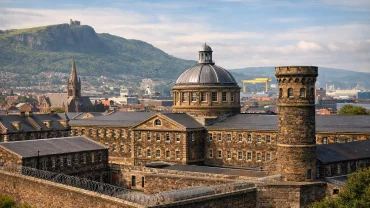
It also helps with nuance. The history of Belfast cannot be explained properly in a one-size-fits-all way. Some guests want a stronger political focus. Others are more interested in social history, murals, prisons, peace-building or how the city changed after the ceasefires. A private format allows the guide to read the room and shape the storytelling accordingly.
What visitors usually take away
Most people do not leave a black taxi tour simply knowing more dates. They leave understanding why Belfast still speaks about its past with such feeling, and why that past cannot be reduced to cliches. They also leave with a stronger sense of the city’s character – proud, complicated, resilient and far more welcoming than old headlines suggest.
That is the real answer to how black taxi tours explain Belfast history. They do it by placing you inside the geography of the story, by interpreting symbols that would otherwise be missed, and by giving the past a human voice. They turn Belfast from a subject into a conversation.
If you are visiting the city and want more than a surface view, this is one of the clearest, most respectful ways to understand it. Belfast does not ask for easy answers, but with the right guide beside you, it becomes far easier to see the people behind the history.

Comment (0)