
Ask ten people what caused The Troubles and you will often hear ten different answers. That is exactly why Troubles history explained properly matters so much in Belfast. What visitors see today – murals, memorial gardens, peace walls, army watchtowers now gone, and neighbourhoods still shaped by division – did not appear overnight. They came from generations of political conflict, social inequality, fear, identity, and loss.
For many visitors, the challenge is not finding places connected to The Troubles. It is making sense of them without reducing everything to a simple Catholic versus Protestant story. Religion was part of identity, but the conflict was also about constitutional status, civil rights, policing, power, discrimination, and competing loyalties to Britain and Ireland. To understand Belfast, you need the wider story and the human one.
Troubles history explained – where the roots begin
The immediate conflict usually dates from the late 1960s to 1998, but its roots go much deeper. A useful starting point is the partition of Ireland in 1921, when the island was divided and Northern Ireland remained part of the United Kingdom. From the beginning, Northern Ireland contained two broad communities with different national aspirations. Most unionists and loyalists, who were mainly Protestant, wanted to remain in the UK. Most nationalists and republicans, who were mainly Catholic, wanted a united Ireland.
That division was not only political. It shaped where people lived, who they voted for, which schools they attended, and how they understood the state itself. In practice, Northern Ireland was governed for decades by a unionist majority at Stormont. Many within the Catholic and nationalist community believed the system was stacked against them through discrimination in housing, employment, and local voting arrangements. Not every Protestant was privileged, and not every Catholic shared the same politics, but the sense of imbalance was real and deeply felt.
By the 1960s, a civil rights movement had emerged, inspired partly by international campaigns for equality. Its supporters called for fairer housing allocation, an end to discriminatory practices, and reform of policing and elections. Those demands were not revolutionary in themselves, but the reaction to them was explosive.
Why the late 1960s became the breaking point
Civil rights marches in Northern Ireland met hostility, counter-protests, and in some cases violence. Television images brought local grievances into homes across these islands and beyond. Tensions escalated sharply in 1968 and 1969, particularly in Derry and Belfast, where serious disorder broke out.
In August 1969, British troops were deployed on the streets. At first, some Catholic areas viewed the army as protection from attacks. That did not last. Relations between the army and nationalist communities deteriorated badly over time, especially after house searches, internment without trial in 1971, and Bloody Sunday in Derry in 1972, when British soldiers shot dead civil rights marchers.
At the same time, loyalist fears were intensifying. Many Protestants believed the state was under attack and that republican violence aimed to force them into a united Ireland against their will. These fears fed support for loyalist paramilitary groups as well as hardline politics. In other words, both communities felt threatened, though not in the same way and not from the same sources.
Who fought during The Troubles?
One reason visitors ask for Troubles history explained in clear terms is that the number of groups can be confusing. The conflict involved state forces, republican paramilitaries, loyalist paramilitaries, and political movements that often overlapped but were not identical.
On the republican side, the Provisional IRA became the best-known armed group. It said it was fighting to end British rule in Northern Ireland and bring about Irish reunification. There were also political organisations connected to republicanism, most notably Sinn Fein.
On the loyalist side, groups such as the UVF and UDA claimed to defend the union with Britain and protect Protestant communities. In reality, loyalist violence often targeted Catholic civilians. Republican violence also killed civilians, as well as members of the security forces and others seen as part of the state. That is one of the hardest truths of the conflict. Although armed groups described their aims in political terms, ordinary people paid a dreadful price.
State forces included the British Army and the RUC, the police force at the time. For some, they represented law and order. For others, especially within nationalist areas, they were seen as partisan or oppressive. It depends very much on whose experience you hear, which is why a balanced account matters.
Belfast’s streets as a map of conflict
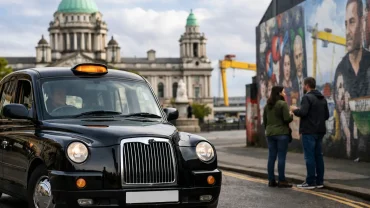
Belfast was one of the main theatres of The Troubles, and the city still carries visible traces of that history. The peace walls, first erected as temporary barriers, became lasting symbols of separation. Murals marked territory, honoured the dead, and expressed political identity. Certain roads and interfaces became flashpoints where fear could turn quickly into violence.
Yet even here, nothing is as tidy as an outsider might expect. Some neighbourhoods suffered repeated attacks and military operations. Others felt the economic damage, social trauma, and constant tension of living nearby. Families learned routines around danger – which route to take, where not to linger, when a situation felt wrong. That everyday reality rarely appears in headline versions of history, but it shaped an entire generation.
This is also why seeing Belfast with local context makes such a difference. A wall is not just a wall. A mural is not just street art. A memorial garden is not simply a place of tribute. Each site sits inside a lived landscape of memory, grief, and identity.
The darkest years and the search for a way out
The 1970s were the deadliest period of The Troubles. Bombings, shootings, punishment attacks, riots, and reprisals became part of life in many areas. Some atrocities remain deeply etched into local memory because of their scale or cruelty, but for many families the defining loss was personal and private, one life taken and never properly repaired.
Political efforts to find a settlement repeatedly stumbled. Power-sharing arrangements were attempted and then collapsed. Security responses intensified. Prison became another battleground, particularly during the hunger strikes of 1981, which had enormous political and emotional impact within republican communities.
Over time, however, it became increasingly clear that there was no outright military victory available to any side. That did not make peace simple. It only created the space for politics to do what violence could not. Secret contacts, public negotiations, ceasefires, setbacks, and renewed talks all formed part of the long road towards agreement.
Troubles history explained through the Good Friday Agreement
The Good Friday Agreement of 1998 is the key political settlement that helped bring the main period of violence to an end. It did not solve every disagreement, and it did not erase pain, but it created a framework for consent, power-sharing, and constitutional politics.
One of its central principles was that Northern Ireland’s status would rest on consent. It would remain in the UK unless a majority voted otherwise. That gave assurance to unionists while recognising the legitimacy of nationalist aspirations. It also established institutions for shared government in Northern Ireland and closer cooperation between North and South.
Another major shift involved policing, prisoner releases, decommissioning of weapons, and a wider effort to normalise politics. None of this was easy. For victims’ families, former prisoners, security force members, and communities that had lived through trauma, the peace process asked people to accept painful compromises. That remains one of the most difficult parts of the story.
Why the past still feels close in Belfast
Visitors are sometimes surprised that peace walls still stand and that segregation in housing and education remains part of daily life. The violence is greatly reduced, but history here is not sealed behind museum glass. It still touches politics, parades, identity, language, remembrance, and how communities relate to one another.
You will also hear different interpretations of the same event. That is not a sign that one side remembers and the other does not. It is a sign that memory itself is contested. In Belfast, history is often experienced through family stories before it is encountered in books. A balanced perspective does not flatten those differences. It acknowledges them honestly.
That is the value of hearing authentic stories from people who lived through these years. A respectful local guide can explain not only what happened, but why a place matters, why language matters, and why certain questions require sensitivity. Belfast Black Taxi Tour was built on exactly that idea – giving visitors a clear, balanced understanding of a complex past through firsthand local knowledge.
The most useful way to approach The Troubles is with curiosity and humility. You do not need to arrive with expert knowledge, but you do need to accept that this was not a single-issue conflict with neat heroes and villains. It was a prolonged and painful struggle shaped by history, politics, class, identity, fear, and failed leadership as much as by ideology.
If you come to Belfast willing to listen, the city will tell you more than any headline ever could. Its story is hard in places, but it is also a story of endurance, candour, and a peace still being worked on every day.
Comment (0)